Gridwood: Guide to Collecting Diamonds Without Running Out of Space
Game guide
Gridwood
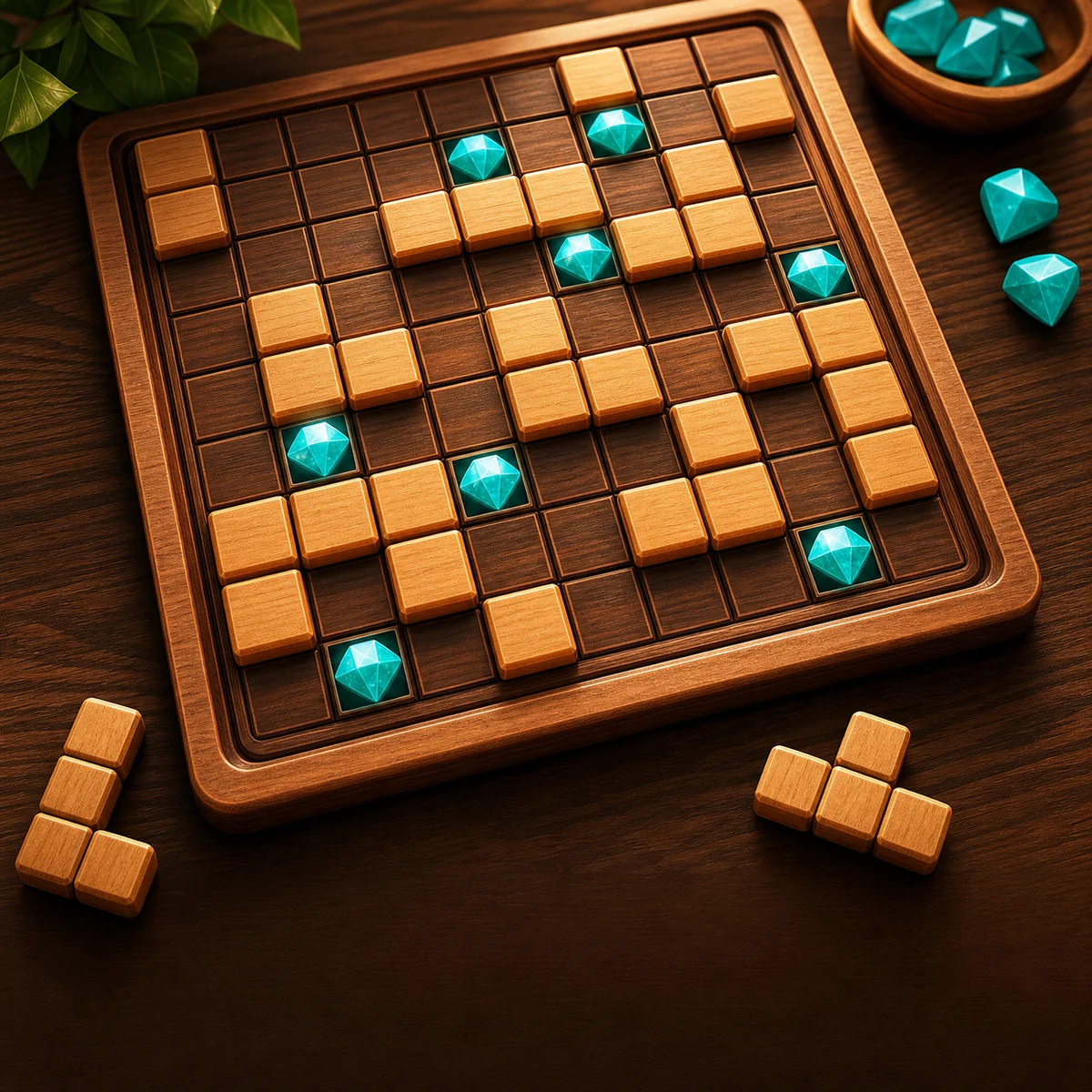
Gridwood blends no-rotation block puzzling with endless diamond contracts. The first contract asks for 15, but the run does not end when you complete it: the total target rises, and you keep playing until no move remains. Jewels are occupied cells: they block placements, count toward completed rows, columns and 3x3 boxes, and are collected when their zone clears.
How Diamonds Are Collected
Diamonds sit on board cells, and you cannot place pieces on top of them. You collect them when you clear the row, column, or 3x3 box that contains the gem. Some tray pieces also bring a jewel instead of wood: once placed, that cell becomes an occupied gem and can help finish a zone if you set it up well.
Endless Contracts
Completing a contract grants a score bonus, resets the diamond counter, and keeps the wood already placed on the board. It does not drop thirty jewels at once: only a small visible stock is active, and that stock replenishes as you collect gems. There is no free board reset: if you finish a contract with the center blocked, the next one begins from that bad position. Each contract asks for more diamonds, and the piece mix gradually makes tiny pieces less common.
Rows, Columns, and 3x3 Boxes
Each move can complete a row, a column, a 3x3 box, or several zones at once. Double clears are especially strong because they open a lot of space and can collect more than one diamond. Because jewels also count as occupied cells, you do not always need to fill a zone with wood: a gem can be the final cell that closes it.
Do Not Block the Center Too Early
The center of the board accepts many different shapes. If you fill it with large pieces or jewels without preparing clears, long pieces and corners become dangerous. Try to preserve connected empty space and use edges for awkward shapes when they do not interfere with a diamond zone.
Read the Whole Tray
You receive three pieces, and the tray only refills when all three are used. Before placing the first one, check whether any piece is hard to fit. If one piece is already limited, use the others to open room for it instead of filling random pockets.
When to Sacrifice Points
A small clear that collects a diamond can be better than a higher-scoring move with no objective value. When you are close to finishing a contract, prioritize the gem and survival. If a jewel piece appears, place it where you can clear it soon: without a plan, it becomes another blocker.
Endgame
The run ends if none of the remaining pieces fit on the board. A very strong player can chain many contracts, but the score is not safely infinite: the board keeps all accumulated pressure, the target rises, and tiny pieces become less common. The key is treating every block as an investment: it should either move you toward a useful clear or leave more space than it consumes.
Ready to apply these tips?
Play Gridwood now
More guides
History of Arcade Games: From the 80s to Today
A journey through arcade game history: the golden age of the 80s, the boom of the 90s, the fall of arcades, and their comeback through mobile, indie, and web games.
How to Master Snake: Strategies and Tips for the Best Score
Learn the best Snake strategies, from movement patterns to advanced board survival techniques.
Chess for Beginners: Complete Guide to Openings and Basic Tactics
Master chess from scratch. Learn essential openings, tactics like forks and pins, and sharpen your real-time online matches.
Solving Sudoku: Techniques from Beginner to Expert
Learn core Sudoku techniques for GameJoc: notes, limited hints, max mistakes, difficulty and scoring.