How to Master Snake: Strategies and Tips for the Best Score
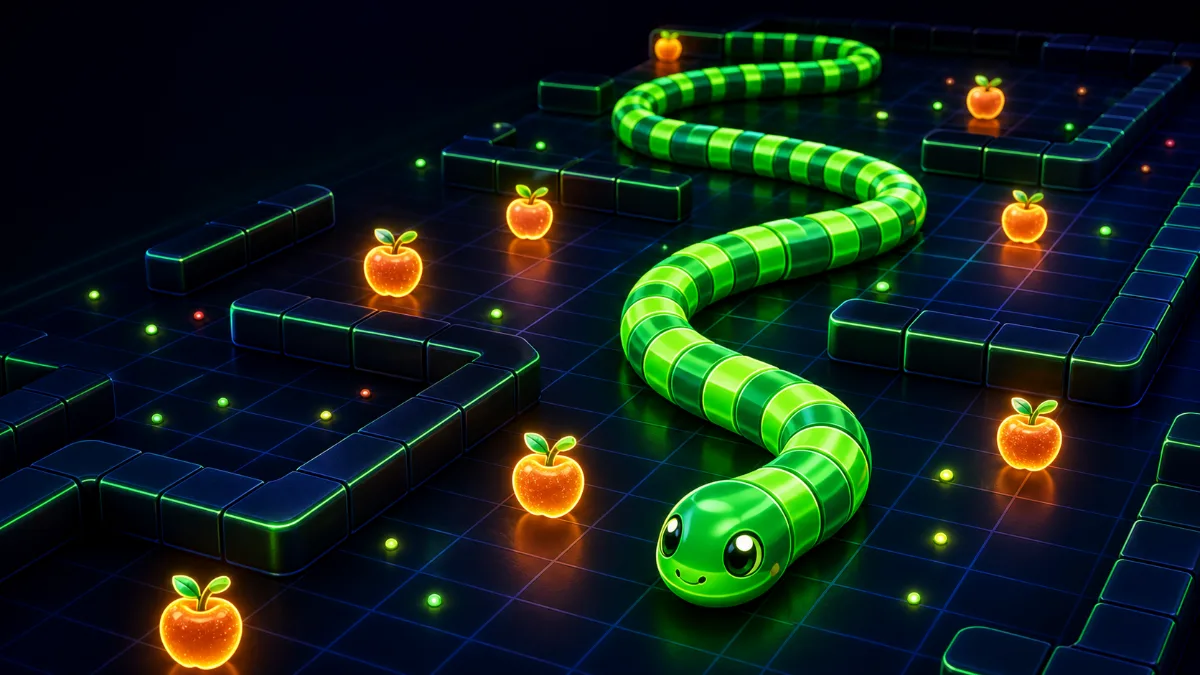
Game guide
Snake
Snake looks simple: eat, grow, don't crash. But behind that mechanic lies a fascinating mathematical problem known as the Hamiltonian Cycle — traversing the entire board without passing the same point twice.
The Golden Rule: Never Block Your Own Exit
The most common beginner mistake is chasing food in a straight line. When your snake is short, it works. But beyond 15-20 segments, every move must consider where your tail will be in the next 5-10 turns.
Practical technique: Imagine the board as a grid. Try to always move in a zigzag pattern that covers all available space, always leaving a free "highway" along one edge.
The Wrapping Edge Pattern
In this version, edges are not walls: the snake reappears on the opposite side. Use that as a shortcut, not as a panic escape. If you cross an edge without checking where your body sits on the other side, you can still crash as fast as in a closed corner.
- Phase 1 (0-30 points): Move freely. The snake is short and there's plenty of space.
- Phase 2 (30-70 points): Start following edges. Create a circuit around the perimeter.
- Phase 3 (70+ points): Interior zigzag. Fill the inner space following a consistent pattern.
Speed Control and Combo
Anticipation matters because pressure rises with every apple. Apples collected with little time between them also maintain a temporary combo that can multiply score up to x8. Chase food quickly only when the exit route is clear; dropping the combo is better than boxing yourself in.
The Food Trap
You shouldn't always go for food immediately. If it appears in a zone surrounded by your body, wait. Complete a full circuit to position yourself better before collecting it. Patience over speed.
What It Trains Cognitively
Snake works well as a cognitive stimulation game because it asks players to anticipate routes, remember their own trail, and resist impulses when food appears in a risky area. The rules are simple, but every second trains attention, spatial planning, and quick decision-making.
- Skills: spatial planning, working memory, sustained attention, inhibitory control.
- Best-fit ages: primary school with short sessions, secondary school, adults.
- Suggested framing: It fits best as playful practice for concentration and executive functions, not as a therapeutic activity.
This framing describes general playful and educational uses; it does not replace professional educational, medical, or therapeutic advice.
Ready to apply these tips?
Play Snake now
More guides
History of Arcade Games: From the 80s to Today
A journey through arcade game history: the golden age of the 80s, the boom of the 90s, the fall of arcades, and their comeback through mobile, indie, and web games.
Chess for Beginners: Complete Guide to Openings and Basic Tactics
Master chess from scratch. Learn essential openings, tactics like forks and pins, and sharpen your real-time online matches.
Solving Sudoku: Techniques from Beginner to Expert
Learn core Sudoku techniques for GameJoc: notes, limited hints, max mistakes, difficulty and scoring.
How to Win 2048: The Corner Strategy That Always Works
Discover the corner strategy to reach 2048 and beyond. Step-by-step guide with examples.