Solving Sudoku: Techniques from Beginner to Expert
Game guide
Sudoku
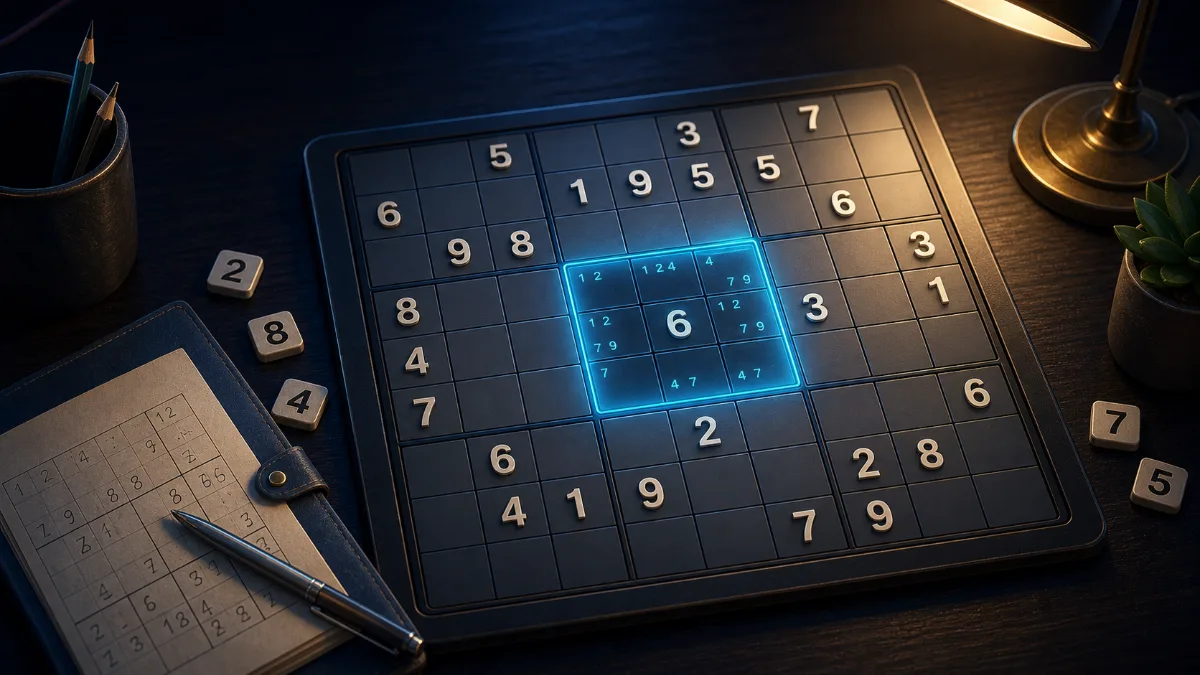
Sudoku is not a math game — it's a game of pure logic. On GameJoc you play a 9x9 board with notes, undo, up to 3 hints, a timer and a 3-mistake limit. Scoring rewards difficulty and speed, but penalizes hints and errors.
Technique 1: Scanning
The most basic technique. For each number (1-9), scan rows and columns looking for where it CANNOT go. If in a 3x3 box only one cell remains possible for a number, that's where it goes.
Technique 2: Naked Pairs
If two cells in the same row/column/box can only contain the same two numbers (e.g., 3 and 7), you can eliminate those numbers from all other cells in that row/column/box. Even though you don't know which goes where, you know 3 and 7 are "reserved."
Technique 3: Hidden Single
Sometimes a cell seems to have multiple candidates, but if you look at the entire row, column, or box, you discover it's the ONLY cell where a specific number can go. That number must go there.
Technique 4: X-Wing (Advanced)
If a candidate number appears in exactly the same two columns across two different rows, you can eliminate that candidate from the rest of those columns. It's like a "cross-block."
General Tip
Use pencil marks (or the game's notes feature). Mark all possible candidates in each empty cell. This transforms Sudoku from an impossible mental exercise to a methodical elimination process.
What It Trains Cognitively
Sudoku is one of the most natural games to position around logic and concentration. It requires holding candidates in memory, applying rules, checking errors, and sustaining attention for several minutes.
- Skills: logic, working memory, sustained attention, executive functions.
- Best-fit ages: secondary school, adults, older adults.
- Suggested framing: It can fit searches around older adults, memory concerns, or menopause as calm mental activity, while avoiding any clinical promise.
This framing describes general playful and educational uses; it does not replace professional educational, medical, or therapeutic advice.
Ready to apply these tips?
Play Sudoku now
More guides
History of Arcade Games: From the 80s to Today
A journey through arcade game history: the golden age of the 80s, the boom of the 90s, the fall of arcades, and their comeback through mobile, indie, and web games.
How to Master Snake: Strategies and Tips for the Best Score
Learn the best Snake strategies, from movement patterns to advanced board survival techniques.
Chess for Beginners: Complete Guide to Openings and Basic Tactics
Master chess from scratch. Learn essential openings, tactics like forks and pins, and sharpen your real-time online matches.
How to Win 2048: The Corner Strategy That Always Works
Discover the corner strategy to reach 2048 and beyond. Step-by-step guide with examples.