Tile Match: Peripheral Vision and How to Process a Chaotic Board in Seconds
Game guide
Tile Match
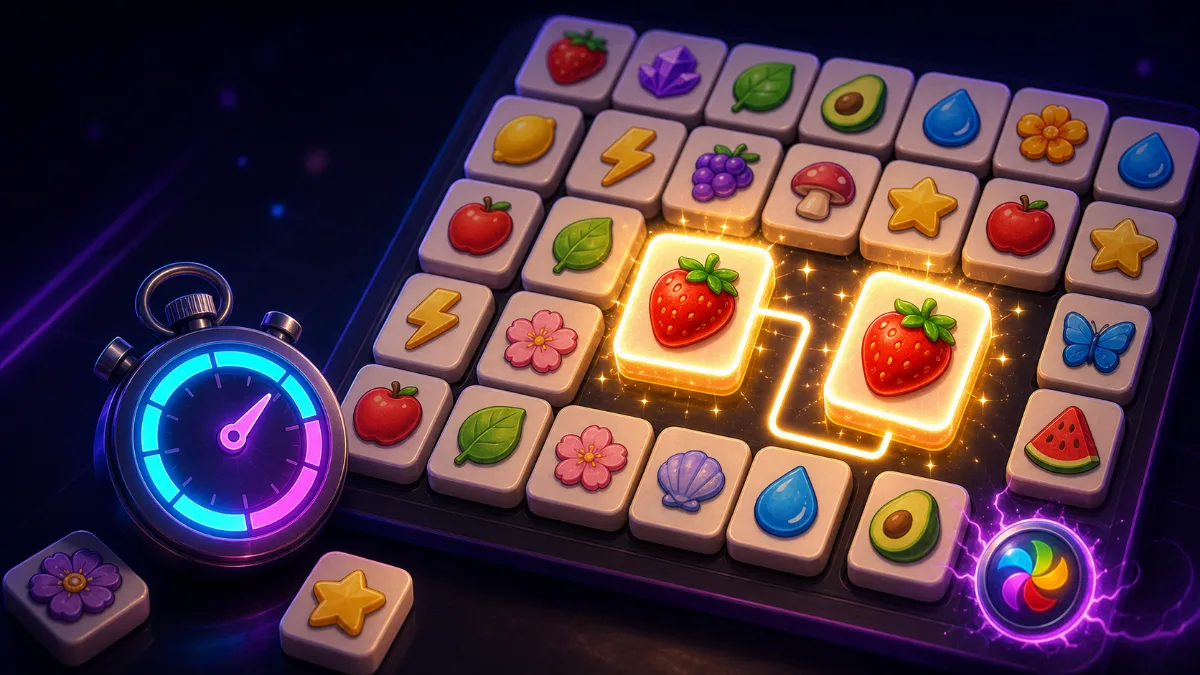
Tile Match has all tiles visible from the start. It's not a memory game — it's a visual processing speed game. The key is training a specific way of seeing the board.
Global Vision, Not Focal Focus
Beginner's mistake: find a tile, find its match, click both, find the next one. This method is slow because it uses focal vision. Advanced method: slightly defocus your eyes (like when searching for a pattern in a dot image) and scan the full board looking for similar "color blobs." The brain detects visual patterns faster than conscious analysis.
Start with the Brightest Colors
Saturated colors (bright red, yellow, orange) are easiest to detect with peripheral vision. Eliminate them first to reduce the board's "visual noise." Once vivid colors disappear, darker or neutral ones are easier to spot.
The -3 Second Penalty: The Biggest Risk
A wrong click costs 3 seconds. In a game where each pair adds a small time bonus that shrinks as the run advances, one error can erase several correct pairs. Rule: if you don't clearly see two tiles match, don't click. Doubt is a signal to stop.
Eliminate by Zones
Don't jump from one corner to another. Work by zones: completely clear the upper half before moving to the lower half. This reduces the visual space you need to process and lets you work faster within each zone.
Time Management: The 5-Second Threshold
When the timer drops below 5 seconds, the brain enters panic mode and visual precision drops. To prevent this: always keep the timer above 10 seconds. If you see it dropping below 15, sacrifice precision for speed temporarily — find an obvious pair quickly even if it's not the most efficient.
What It Trains Cognitively
Tile Match is not classic memory: all tiles are visible, so the challenge is processing the board, spotting matches, and avoiding wrong clicks. It fits selective attention, peripheral vision, and processing speed very well.
- Skills: selective attention, processing speed, visual discrimination, peripheral vision.
- Best-fit ages: primary school, secondary school, adults.
- Suggested framing: It is better presented as a fast visual-attention game than as a memory game.
This framing describes general playful and educational uses; it does not replace professional educational, medical, or therapeutic advice.
Ready to apply these tips?
Play Tile Match now
More guides
History of Arcade Games: From the 80s to Today
A journey through arcade game history: the golden age of the 80s, the boom of the 90s, the fall of arcades, and their comeback through mobile, indie, and web games.
How to Master Snake: Strategies and Tips for the Best Score
Learn the best Snake strategies, from movement patterns to advanced board survival techniques.
Chess for Beginners: Complete Guide to Openings and Basic Tactics
Master chess from scratch. Learn essential openings, tactics like forks and pins, and sharpen your real-time online matches.
Solving Sudoku: Techniques from Beginner to Expert
Learn core Sudoku techniques for GameJoc: notes, limited hints, max mistakes, difficulty and scoring.