Neuro Link: Flow Technique to Solve Cable Puzzles in Seconds
Game guide
Neuro Link
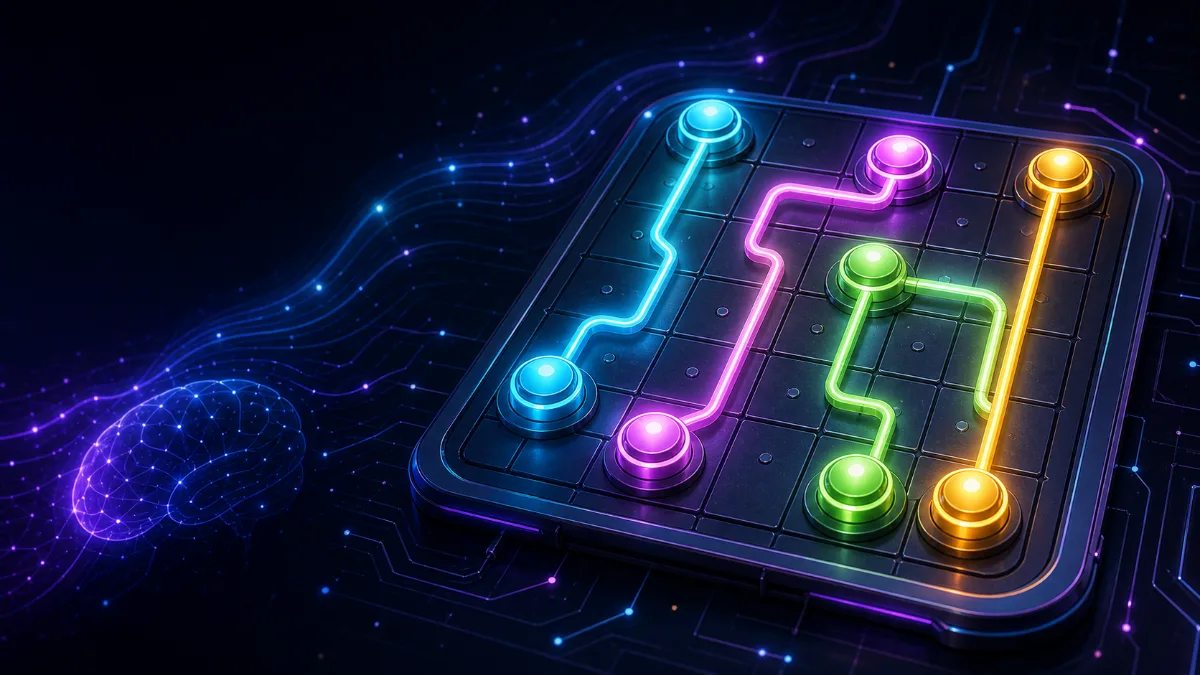
Neuro Link is an arcade game about connecting same-color nodes without cables crossing. In Blitz mode, speed matters as much as the solution. There's a strategy that cuts solving times in half.
The Periphery-First Strategy
Before drawing any cable, look at nodes stuck to the outer edges of the grid. These nodes have fewer route options — in many cases, there's only one way to connect them without going off-grid. Solve them first and the center cables will simplify themselves.
The Curve Pattern
Neuro Link puzzles always have a solution. If a path seems impossible, you're probably blocking with another cable. The rule: when a cable needs to "turn the corner" to reach its destination, route it along the outer edge before the inner edge. Inner cables going straight are easier to manage.
The Combo System: Don't Underestimate It
Solving puzzles quickly in chain multiplies your score up to ×3. The difference between ×1 and ×3 can be huge by the end of a 60-second run. To maintain the multiplier, use the early 5x5 and 6x6 grids at maximum speed. If a cable crosses, correct by erasing that route before rebuilding the whole board.
8x8 Grids: 1-Second Mental Pause
When a large grid (8x8) appears, the temptation is to attack immediately. Better: pause 1 second and mentally trace the route of the two hardest pairs (usually ones in opposite corners). With that route clear, the rest of the puzzle resolves in chain.
Using Skip Strategically
Skip costs 5 score points and breaks your combo streak. Use it only if you have been stuck for several seconds. In that case, the penalty is smaller than losing half the run blocked. After the skip, focus on completing 2-3 quick puzzles to recover the multiplier.
What It Trains Cognitively
Neuro Link relies on spatial planning: connecting nodes without crossing lines asks players to see the whole board, reserve paths, and choose which pair to solve first. Blitz mode adds processing speed and pressure control.
- Skills: spatial planning, visual speed, selective attention, problem-solving.
- Best-fit ages: secondary school, adults, fast-puzzle players.
- Suggested framing: Because of the timer, it suits teens and adults looking for a fast-attention puzzle.
This framing describes general playful and educational uses; it does not replace professional educational, medical, or therapeutic advice.
Ready to apply these tips?
Play Neuro Link now
More guides
History of Arcade Games: From the 80s to Today
A journey through arcade game history: the golden age of the 80s, the boom of the 90s, the fall of arcades, and their comeback through mobile, indie, and web games.
How to Master Snake: Strategies and Tips for the Best Score
Learn the best Snake strategies, from movement patterns to advanced board survival techniques.
Chess for Beginners: Complete Guide to Openings and Basic Tactics
Master chess from scratch. Learn essential openings, tactics like forks and pins, and sharpen your real-time online matches.
Solving Sudoku: Techniques from Beginner to Expert
Learn core Sudoku techniques for GameJoc: notes, limited hints, max mistakes, difficulty and scoring.