Battleship: Ship Placement and Shot Deduction
Battleship guide: ship placement, parity shots, finishing hits, online room play, and maximizing AI-mode score.
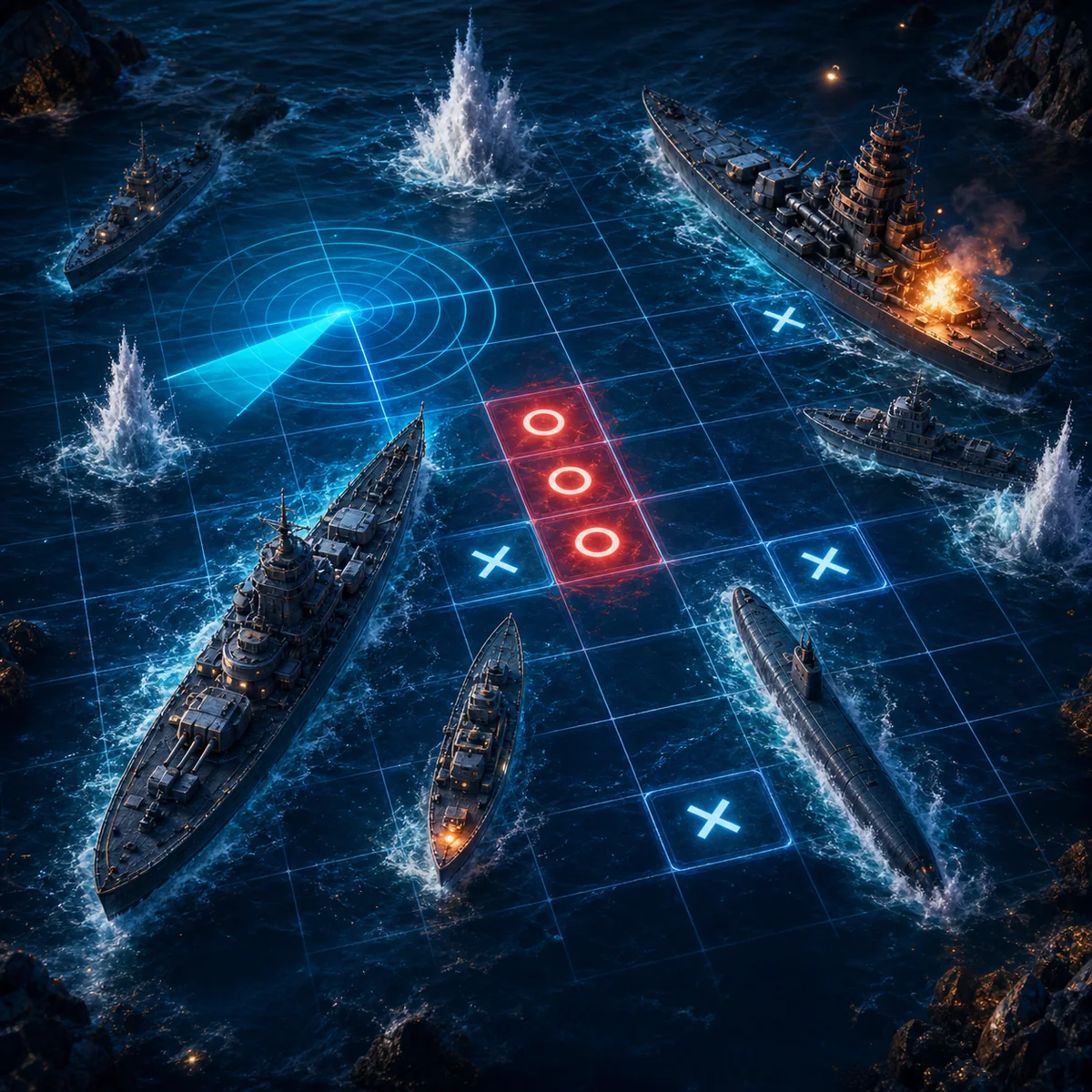
Battleship looks like a luck game until you start reading the board as an information problem. Every shot removes possibilities, every hit suggests a likely orientation, and every sunk ship changes the best way to search for the next one. On GameJoc, you can play the AI with a local score or create real-time online rooms to face another person.
Placement: Do Not Give Away Patterns
The first mistake is placing all ships close together or in obvious lines. If the AI finds one end, it can chain nearby shots and turn one hit into a lot of information. Spread the fleet, mix orientations, and avoid letting two ships form a readable line. Strong placement is not about hiding one perfect ship: it is about making each enemy hit reveal as little as possible.
Avoid Overusing Corners
Corners feel safe, but many players use them by habit. Placing a long ship against a corner reduces its possible layouts and can make it easier to infer. Use edges sometimes, but do not make the perimeter your main pattern.
Use Parity Shots
While hunting for large ships, you do not need to fire at every square. Since ships occupy multiple cells, you can alternate targets like a checkerboard to cover more possible placements with fewer shots. This is called parity: instead of testing every point, you test a grid that forces any ship of size 2 or more to cross one of your target cells.
After a Hit, Change Modes
A hit should not be played like normal searching. First test nearby directions to identify orientation. Once you get two aligned hits, continue along that line until the ship sinks. If one end misses, return to the other end. The key is to avoid spending shots around a hit without a clear hypothesis.
After Sinking, Reset Your Deduction
When you sink a ship, stop chasing adjacent squares that can no longer belong to that ship. If the game marks the sunk ship, use that information and switch to another zone. Many points are lost by over-firing around a ship that is already solved.
Review Your AI Game
Battleship does not have a global leaderboard enabled on GameJoc. AI mode shows a local score at the end: use it to compare your own games, not as a public ranking. Review wasted shots and how you resolved each hit. Change your hypothesis when a line fails, without treating a fast game as a guaranteed victory.
Online Room Mode
Online matches do not submit leaderboard score: they are about reading a real opponent. Create a room, share the code, or protect the match with a password. Once the host starts, both players place their fleets and tap Ready; the server validates the ships and sends the discovered information from the rival board, keeping unrevealed ships hidden during normal play.
Read the AI
The AI does not fire completely at random: after finding a hit, it tends to search nearby and confirm orientation. That makes compact ship placement dangerous. If two ships are too close, one hit can accidentally lead it into another. Leave water between ships and force the AI to restart its search after each sunk target.
Processes involved in play
Battleship requires updating position and orientation hypotheses with each shot. Switching parity search to finishing hits is a partial-information decision: the opposing board remains hidden beyond discoveries.
- Skills: probabilistic reasoning, spatial deduction, planning, working memory.
- Suggested audience: upper primary school, secondary school, adults, older adults.
- Suggested framing: No global leaderboard is enabled. The deduction described belongs to the game, without a therapeutic-training promise.
This framing describes general playful and educational uses; it does not replace professional educational, medical, or therapeutic advice.
Put it into practice
Battleship
Keep exploring
History of Arcade Games: From the 80s to Today
A journey through arcade game history: the golden age of the 80s, the boom of the 90s, the fall of arcades, and their comeback through mobile, indie, and web games.
How to Master Snake: Strategies and Tips for the Best Score
Learn the best Snake strategies, from movement patterns to advanced board survival techniques.
Chess for Beginners: Complete Guide to Openings and Basic Tactics
Master chess from scratch. Learn essential openings, tactics like forks and pins, and sharpen your real-time online matches.
Solving Sudoku: Techniques from Beginner to Expert
Learn core Sudoku techniques for GameJoc: notes, limited hints, max mistakes, difficulty and scoring.