Color Sequence: Memory Techniques to Remember Long Patterns
Game guide
Color Sequence
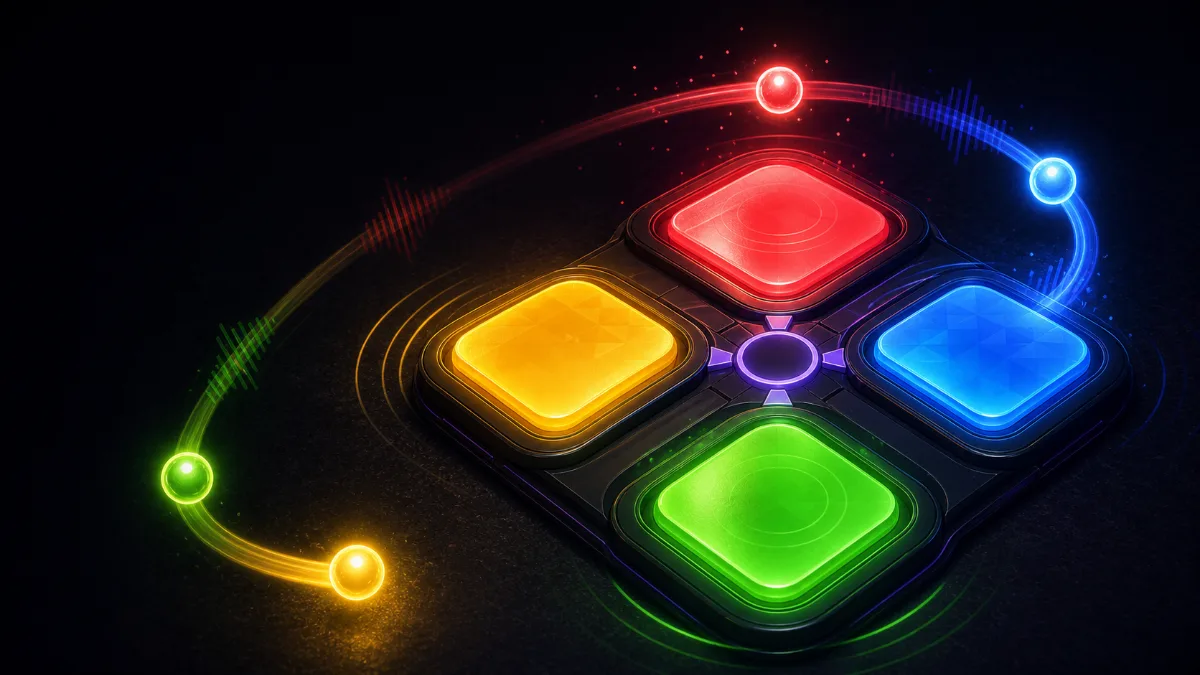
Color Sequence is the digital version of classic Simon Says. The game adds one new color to the sequence each round. The limit seems to be memory, but there are techniques that allow remembering 30+ step sequences without effort.
Sound is More Important Than Color
Each color has its own associated sound. First learn the real color-sound relationship: green = highest tone, red = mid-high, yellow = mid-low, and blue = low. Once memorized, you can replay the sequence as a musical melody in your mind, which is far easier to remember than a visual sequence.
Chunking: Group in Sets of 3
Don't try to remember each color separately. Group the sequence in sets of 3. For example: "Red-Blue-Green / Yellow-Red-Blue / Green-Green-Yellow." The human brain comfortably handles groups of 3, and this technique effectively multiplies your working memory capacity.
Internal Narration
Count the sequence aloud internally using short words: "Re-Bl-Gr / Ye-Re-Bl..." This activates the phonological loop of working memory — a different memory system than visual that acts as backup. When visual memory fails, phonological often remembers.
The Speed Trap
In advanced rounds, the sequence plays faster. The trap is trying to memorize faster. In reality, you should simplify your mental representation — fewer details, more global patterns. "Four blues in a row" is easier to remember than "blue, blue, blue, blue."
Error Recovery
If you fail on a step, don't give up or lose your mental rhythm. Replay the sequence from the beginning in your mind while the game shows it again. The second exposure consolidates memory — use it by focusing on the point where you failed.
What It Trains Cognitively
Color Sequence is one of the clearest fits for memory. Each round adds new information and asks players to retain order, color, and sound. It is ideal for explaining working memory, sustained attention, and chunking strategies.
- Skills: working memory, visual memory, auditory memory, sustained attention.
- Best-fit ages: primary school, secondary school, adults, older adults.
- Suggested framing: It may interest families looking for playful memory activities for older adults; it should not be presented as a tool to diagnose or treat Alzheimer’s.
This framing describes general playful and educational uses; it does not replace professional educational, medical, or therapeutic advice.
Ready to apply these tips?
Play Color Sequence now
More guides
History of Arcade Games: From the 80s to Today
A journey through arcade game history: the golden age of the 80s, the boom of the 90s, the fall of arcades, and their comeback through mobile, indie, and web games.
How to Master Snake: Strategies and Tips for the Best Score
Learn the best Snake strategies, from movement patterns to advanced board survival techniques.
Chess for Beginners: Complete Guide to Openings and Basic Tactics
Master chess from scratch. Learn essential openings, tactics like forks and pins, and sharpen your real-time online matches.
Solving Sudoku: Techniques from Beginner to Expert
Learn core Sudoku techniques for GameJoc: notes, limited hints, max mistakes, difficulty and scoring.